Saturday, October 6, 2012

The Nexus Shooting Difference - Part 2 - Bullet Traps

Arguably, the single most important piece of safety equipment on a shooting range is the bullet trap.  A properly constructed trap is vital to prevent bullets exiting the range and harming people and property outside of the range.  But, an often overlooked aspect that is equally as important, it that it must capture and prevent ricocheting bullets to prevent harm to the patrons inside of the range.  There are a wide variety of bullet traps in existence including granulated rubber traps, steel funnel traps at each lane, wide open steel funnel traps, or even a dirt berm in a basement.  All of these serve the primary purpose of ensuring that bullets do not exit the range adequately.  But, only one of these is the best at protecting the shooters inside of a range. 

The  steel funnel type of trap at each individual lane seen below is very common at indoor ranges.  Why?  Because it is relatively inexpensive.  The problem with this kind of trap is that the very narrow opening that leads to the bullet deceleration chamber can clog with lead residue over time and eventually these openings can fill up to the point that bullets strike the buildup and ricochet erratically.  Also, the presence of vertical partitions between each trap provides a second area where bullets can and have ricocheted.


Although rubber traps do a very good job of capturing bullets and are very cost effective initially, they are subject to a high degree of maintenance.  These traps can work just fine as long as the are regularly maintained every few weeks to months depending on the volume of shooting.   However, if the rubber traps are not cleaned out frequently, a large pocket of lead can build up in a highly concentrated area.  As the superficial layers of rubber are worn away and this lead ball builds up to the surface of the trap, the likelihood of a bullet striking this large metallic mass increases, as does the chance of dangerous ricochets.


We could have easily equipped our range with one of these less expensive traps; however, just as we spared no expense obtaining the best ventilation system possible to protect our customers' health, we purchased the safest trap available despite the fact that it costs considerably more than these other options.  Thus, we decided to go with Action Target's Total Containment Trap for our rifle lanes.  These are the same traps used at many military and law enforcement installations.  The design of this steel ramp guides bullets into a deceleration chamber with no intervening vertical components present that could cause dangerous ricochets.   This trap is not subject to the same maintenance requirements as rubber traps as the spent lead is automatically and continuously collected into containers by a mechanical auger system.  So, patrons can shoot without worrying about whether the range management is performing the necessary maintenance to ensure safety because for the Total Containment Trap it is being maintained continuously!


In fact it is so safe that shooters involved with tactical training will be permitted to shoot as close as only 1 yard away!  Also, for tactical shooters you can shoot at any angle all the way across the entire width of the range from a single position due to the lack of vertical obstructions.  


Watch the video below to see an officer fire as close as 1 yard away and shoot  an AR-15 at multiple angles!


On the pistol side of the range, we will be utilizing Action Target's flat trap which incorporates an angled metal plate that stops bullets, but we will also have multiple layers of self healing rubber curtain which prevents splatter and ricochets.  When a bullet passes through this rubber material, a 9 mm bullet leaves a hole only the size of a pinhole enabling the curtain to take hundreds of thousands of rounds before needing replacement.  The curtain prevents any backsplatter or ricocheting metallic fragments from reaching the shooter. 


Nexus Shooting is committed to shooter safety and well being.  In the next additions of our Nexus Shooting Difference series, we will continue to detail our plan to create the best possible indoor shooting range environment by covering topics such as sound abatement, innovative safety products, and more.

Saturday, September 29, 2012

Construction update #2: The storefront has come a long way!


Sorry about the long delay since our last construction update.  As you can see in the animated slideshow, the build has been humming along and at this point the storefront is very recognizable.  We are getting closer to achieving our vision of an eye-catching, modern, and unique piece of architectural art!

Friday, September 28, 2012

The Nexus Shooting Difference - Part 1 - Range ventilation

We will be writing a multi-article post describing features of Nexus Shooting that will set us apart from the typical shooting range.  For this first article, let's discuss the important topic of range ventilation.

Lead poisoning is a very real problem with many shooting ranges.  The Center for Disease Control / National Institue for Occupational Safety and Health (CDC/NIOSH) has published the following guidelines for preventing occupational lead exposure which also includes many case reports of lead poisoning from shooting.  Feel free to peruse their recommendations and the case reports by clicking this link:  http://www.cdc.gov/niosh/docs/2009-136/pdfs/2009-136.pdf

Lead poisoning can induce nausea, vomiting, headache, high blood pressure, abdominal pain, memory and mood disorders, and alter fertility.  Because of these significant effects, lead levels of shooting range employees are very strictly regulated.  Have you ever seen any of the employees at a range wearing one of these?

 
It is because their blood lead levels tested abnormally higher than allowed!   Fortunately, they have the good sense to follow the recommended testing and prescribed intervention.  But, these guidelines are for EMPLOYEES of ranges.  Where are the guidelines for CUSTOMERS of gun ranges?  THERE ARE NONE!

Besides lead, there are all sorts of different byproducts of shooting which can be inhaled.  Carbon monoxide, gunpowder, smoke, etc.  Below is an actual picture of a standard N95 filter mask (in front)that has turned visibly grey after shooting 100 rounds in a poorly ventilated range (a new clean filter is in back for comparison).  Clearly, this is garbage that you do not want to inhale!


So, how is a ventilation system designed to prevent inhaling all of these shooting byproducts and help reduce the chance of lead poisoning?  The recommendations by the CDC/NIOSH state "Perforated radial air diffusers mounted at ceiling height have been tested and demonstrated effective in meeting established industry and regulatory air flow criteria.  Diffusers that produce jets of air can create turbulence at the firing line." - page 14 of  guidelines for preventing lead exposure

This diagram shows ceiling air diffusers which draw outside hot air in and  produce swirling air and turbulence.  Clearly, this is ineffective at properly ventilating the range.  Additionally, the introduction of jets of cold air from standard air conditioning vents disrupts air flow, causes turbulence, and is only minimally successful at producing "warm" air.  Even worse, some ranges only turn on the ventilation sporadically to save on energy costs!


The diagram below shows what optimum airflow from a radial diffuser looks like.  The air moves as a single mass, all in a downrange manner, in a laminar fashion with NO turbulence at 75 feet per second.  The ventilation system should be on the whole time.
 
 
The above radial diffuser works great at ventilation, but the problem with the this setup is that it draws its supply from the hot humid outside air.   Some ranges try to band-aid fix this by introducing those same standard air conditioning vents which cause jets of air, disrupt the laminar airflow, and result in turbulent warm air as shown below.  With this type of system you are back to square one with a poorly ventilated sauna!


The best way to obtain the combination of great ventilation AND ice cold air is to cool ALL of the air coming out of the radial diffuser while recirculating a portion of the cold air through multiple layers of HEPA filtration as shown below.  Obviously, this is the ideal situation to have at an indoor shooting range.  So, why don't all ranges use this system?   Because it costs about FIVE TIMES more in just the capital costs of the equipment alone and cooling the entire volume of air sends the electric bill through the roof!  But, because we are committed to providing the best shooting environment possible, we are installing this ventilation system, which literally costs $1 million!  This is the same exact system used in many military and law enforcement indoor ranges.


As a medical doctor, I am acutely aware of the numerous health risks present in most pre-existing shooting ranges. At Nexus Shooting, if we can provide the healthiest and safest environment for shooters, we can sleep easy at night knowing that we care about our customers and are not just trying to maximize the bottom line.  

- Dr. Bernard Hsiao, MD. Ph.D, co-owner of Nexus Shooting.


Saturday, August 25, 2012

Refined Renderings of the Retail Space Interior Design

The absolute last thing that we would want to do is the same boring cookie-cutter store that everyone is already familiar with.  If you've seen inside one shooting range and firearms store, you've basically seen all of them.  Everyone has the same crowded and cramped rectangular box shaped store, wood racks, generic glass counters, guns on peg boards, banners of manufacturers on the wall, animal head trophies, etc.

Our vision for a unique shooting experience is clearly evident in the design of our modern eye catching building exterior (see this post from March 6th).  Now, we are applying that same vision to our interior.  Below are a couple of concepts. 

This first one was our attempt at really emphasizing the technology and state of the art characteristics of our range. We were going for a futuristic feeling similar to what you might find at Epcot or on the bridge of the Starship Enterprise, but in the end felt that this would be too extreme and probably a bit too sterile.  Click each picture for a larger view.


Below are some of the latest renderings.  These are a lot closer to what the final product will actually be.  Warm, spacious, clean, modern, and inviting but still packed full of technology and innovative ideas.  This is a space you will really feel comfortable in and receive the best service anywhere.  Get ready for a first class shooting experience!


Sunday, August 12, 2012

Construction update #1 - Footers ready to be poured

Here's a video of the current state of the construction site:


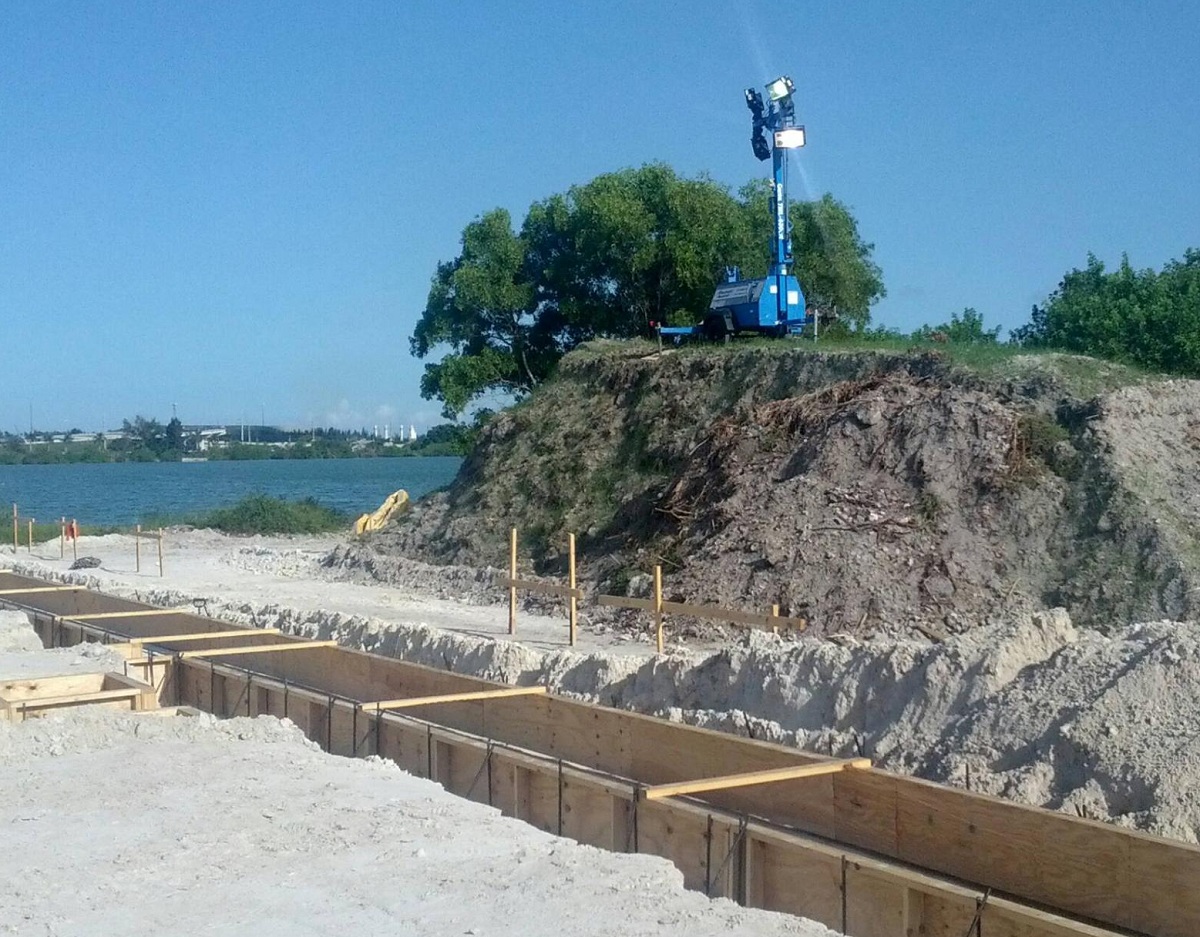
Clilck the pictures below for larger images.  The lot has been completely cleared of shrubbery, and our beautiful view of the lake is now visible!


The framing for our footers is built and ready for the cement. The framing already gives you a good idea of the layout and size of the range. 


We will be fast tracking construction, so these powerful floodlights will allow our crews to work through the night!


Sunday, August 5, 2012

Nexus Shooting has official broken ground! July 20, 2012!


On July 20, 2012 we officialy broke ground!  We will be fast tracking construction, so if you drive by the site you should see rapid progress.  We will post periodic updates of the building as it is going up as well.  Click on the individual pictures for larger view.

Pictures of the virgin site... check out our lakefront property!
 Moving some earth!


 Nexus Shooting custom built ground breaking hardware: